Light-DuoAttention:CuTeDSL 与 SGLang 实践
在 SGLang 中支持 DuoAttention 运行 NIAH 测试(原文章的 9 秒演示)。
Background
Dense attention 的 prefill 对长度 N 的序列处理二次量级的 Q–K 配对;有 KV cache 时,decode 每步只有新 query,对历史的扫描则随 N 线性增长。减少 prefill 计算、decode 读取量和持久 KV 容量,是三个相关但不同的目标。
StreamingLLM 只保留初始 attention sink 与最近窗口,可用固定缓存持续处理流式输入,代价是窗口外的旧内容无法被重新检索。“持续处理长流”不等于保留无限历史记忆。Quest 则保留历史 KV,用每页 Key 的统计信息估计 query 相关性,挑选页面参与 attention;它主要减少每步读取和计算,而不是自动缩小全部历史 KV 的存储容量。
DuoAttention 的选择落在 head 维度:部分头需要检索远处内容,保留完整历史;其余头只使用 sink 与近期窗口。收益因此受检索头比例约束,质量则取决于哪些头被分到流式分支。论文 §2 的头划分与 Light-DuoAttention 的 kernel、SGLang 接线是不同层次的工作。
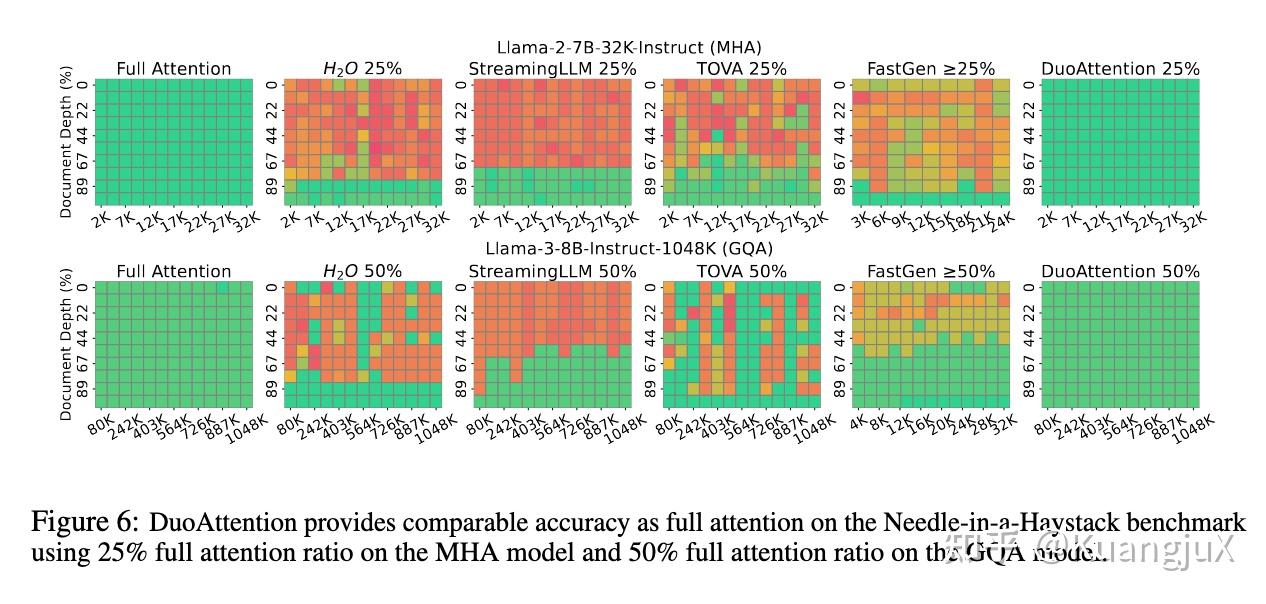
不同稀疏注意力方法在大海捞针测试中的准确率
上图展示了 Full Attention,DuoAttention 与 StreamingLLM 等其他不同稀疏注意力方法在 Needle-in-a-Haystack 上的准确率测试。这张论文图支持头划分能够改善检索质量的判断;它不是下文 H800 kernel 的性能测量。
DuoAttention
DuoAttention 的关键洞察是,LLM 能够被识别为两种类型的头,分别被称为检索头(Retrieval Heads)和流式头(Streaming Heads),检索头仅占一小部分,但需要对全部上下文进行处理;而流式头仅仅需要关注最近的词元(recent tokens)和注意力汇聚词元(attention sink)。DuoAttention 通过针对检索头和流式头的二分性,针对不同头使用不同的注意力,从而显著加速 LLM Inference 的 Prefill Decode 过程,并减少内存占用。
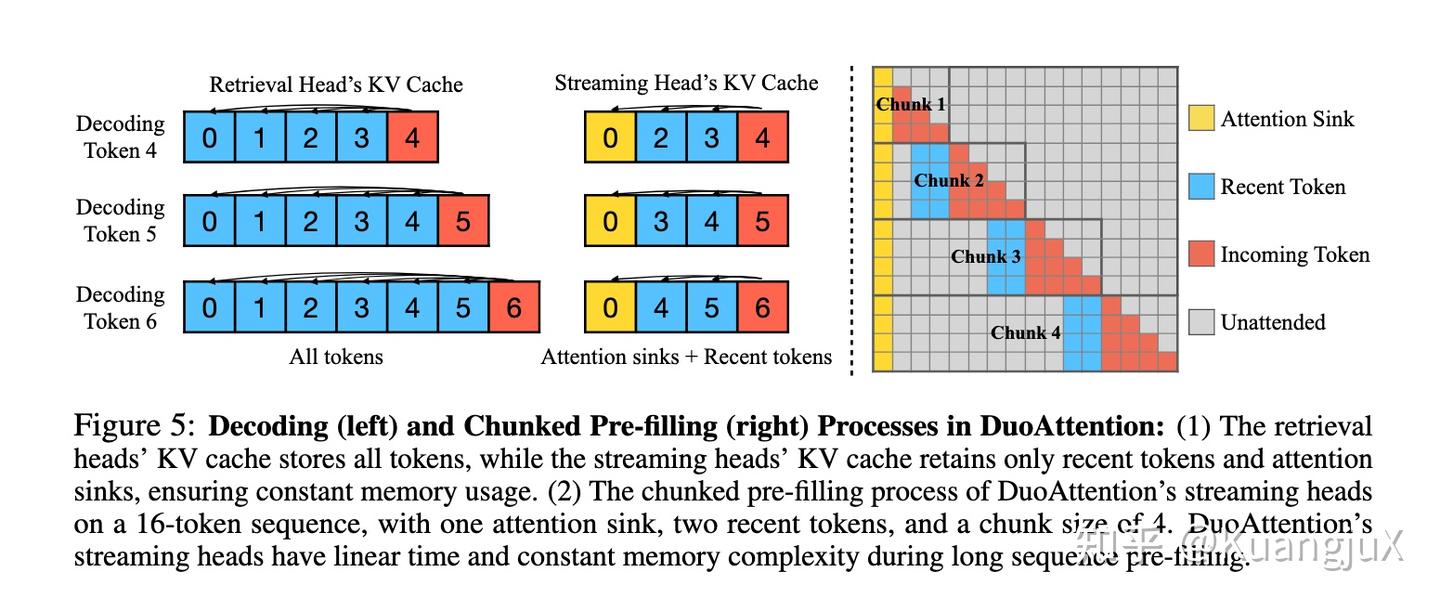
DuoAttention 针对 Decode 和 Chunked Prefill 的处理流程
DuoAttention 针对 Prefill 阶段和 Decode 阶段有不同的处理:
- Decode:在 Decode 阶段,DuoAttention 为 LLM 的每一层分配两个 KV Cache,一个用于检索头,存储所有历史 KV;一个用于流式头,仅存储注意力汇聚和最近的词元,并保持大小恒定,当处理一个新词元的时候,Query,Key,Value 会沿着 Head 维度进行切分,分别计算检索头的完整注意力和流式头的流式注意力。最终按照 Head 维度连接起来得到输出投影。
- Prefill:按 chunk 处理 prompt,流式头在块间保留 sink 与窗口。设序列长 L、chunk 大小 C、保留窗口总长 W,则直接按块计算的流式分支处理量为 O(L(C+W)),工作集为 O(C+W);当 C 与 W 同阶为 K 时,才简写为 O(LK) 和 O(K)。检索头仍访问完整历史,因此整个模型不会随流式分支一起变为固定缓存。
例如保留 128 个 sink、256 个近期 token,某层一半 KV heads 为检索头,在历史长 N 且 N 远大于 384 时,该层持久 KV 元素量约为全缓存的 0.5 + 0.5 × 384/N。这只是相同 dtype/head_dim 下的容量估算,不包括 chunk 临时状态和分配器开销,也不是本项目 prefill 集成的实测收益。
除此之外,DuoAttention 需要通过训练来获得流式头和检索头的信息。DuoAttention 通过知识蒸馏进行训练,定义全注意力模型
同时,DuoAttention 为了节省资源,通过引入一个门控值来决定哪些头开启全量计算,哪些可以简化。通过引入损失函数
最终 DuoAttention 通过总损失函数
Light-DuoAttention Kernel Design
Light-DuoAttention e1d9e4d2 基于 Hopper 的 CuTeDSL attention 实现 streaming mask,并提供 SGLang prefill 接入示例。原实验在 H800 上使用 Llama-3-8B 和 DuoAttention 官方头划分参数。这里的实现证据是 streaming kernel 与 prefill 路径;论文的 decode 双缓存、流式 KV 驱逐及完整端到端内存收益,不能由这条接线推得。
PyTorch reference 用掩码明确语义:query 只能看到因果范围内的初始 sink_size 个位置,以及包含自身的最近 local_size 个位置。Sink 的作用是保留注意力归一化所需的初始位置,不要求这些 token 在语义上重要;序列开头的 query 也不能看到尚未出现的 sink token。
因此在 PyTorch 最重要的部分就是构建掩码,并将掩码应用到 Attention Score 中:
beyond_causal = col_idx > row_idx
outside_window = torch.logical_and(
   col_idx < row_idx - (local_size - 1), col_idx >= sink_size
)
mask = torch.logical_or(beyond_causal, outside_window)然而,FlashAttention3 并非如 PyTorch 一样是直接将掩码应用在注意力分数中,而是通过分块对 Q,K,V 进行计算,因此当我们应用掩码的时候,需要同时对块内掩码以及块间掩码进行考虑:
- 块内掩码:针对块内掩码,我们需要修改
mask.py找到当前线程所持有的寄存器在整个 Attention Score 中的绝对位置,并根据位置进行原地的掩码应用。 - 块间掩码:针对块间掩码,我们需要修改
block_info.py来获取能够应用 Attention Sink 和 Recent Tokens 的块。
块间跳过只减少遍历范围,块内 mask 仍要精确处理窗口交界、因果边界和尾块。下面是等价条件的机制伪代码,window_size_left 不包含当前 query 本身;实际 CuTeDSL 实现还需要线程坐标映射与编译期条件。
is_in_sink = k_pos < sink_size
is_in_window = window_size_left is None or k_pos >= q_pos - window_size_left
allowed = k_pos <= q_pos and (is_in_sink or is_in_window)
if mask_seqlen:
    allowed = allowed and k_pos < seqlen_k
if not allowed:
acc_S[i] = -inf例如 query 的绝对位置为 1000,sink_size=128、local_size=256,则可见区间是 [0,127] 与 [745,1000]。两段之间的完整块可以跳过;跨越 127 或 745 的块仍需逐元素 mask。短序列时两段可能重合,块遍历不能重复累计同一 KV。
为了支持 Chunked Prefill,我们需要额外引入一个名为 position_ids 的变量,含义为当前 Query 中的位置编号。这是由于,当我们计算 Chunked Prefill 的时候,每次处理只能拿到 Query 的相对位置而不是绝对位置,这样当我们去计算要不要为 Attention Sink 支持,我们无法通过相对位置来判断当前结果是否在 Attention Sink 的区域内。因此,我们需要 position_ids 来去首先找到当前结果所在的绝对位置,随后再去进行掩码处理。
SGLang Integration
最后,我们需要在 SGLang 中支持 DuoAttention 并运行 LLama-3-8B 模型,当前我们使用 DuoAttention 代替了原生 SGLang 的 Prefill 阶段,原生 SGLang 的 Prefill 实现在 FlashAttentionBackend 中的 forward_extend 中,我们需要定义一个新的参数 enable_duo_attn,当开启这个参数的时候,我们执行 DuoAttention。我们需要从 Query,Key,Value 中对多头进行检索头和流式头的切片,并在最终进行连接(Concat)结果并获得最终结果。
头划分会引出访存组织问题:若两类 heads 交错排列,每次调用都需 gather/scatter。DuoAttention 部署时预先重排投影通道,将同类 heads 放在连续区间,用一次性的权重变换换取推理中的切片访问;输出投影必须应用匹配的列置换,才能保持 head 输出的对应关系。
为了方便且高效地进行切片和连接操作,我们需要预先对 Query,Key,Value 以及 Output 进行重新排列,将流式头和检索头放到两个不同的连续簇中,这样就不需要进行 Scatter 以及 Gather 操作了。在 SGLang 中,我们将这个阶段放到 ModelRunner 中进行处理:
for i, layer in enumerate(layers):
    attn = layer.self_attn

    # kv_pattern defines which KV head group is full (1) or streaming (0)
    kv_pattern = torch.tensor(full_attention_heads[i], device=device, dtype=torch.int)
    assert len(kv_pattern) == num_kv_heads

    # Get the indices for full and streaming KV heads
    kv_full_indices = torch.where(kv_pattern == 1)[0]
    kv_stream_indices = torch.where(kv_pattern == 0)[0]

    # Expand the KV pattern to the Q heads
    q_head_pattern = torch.repeat_interleave(kv_pattern, repeats=gqa_group_size)
    q_full_indices = torch.where(q_head_pattern == 1)[0]
    q_stream_indices = torch.where(q_head_pattern == 0)[0]

    # --- 2. Reorder Q, K, V Projection Weights ---
    # For models with a combined QKV projection matrix (e.g., Llama)
    if hasattr(attn, 'qkv_proj'):
        qkv_weight = attn.qkv_proj.weight.data
        q_size = num_heads * head_dim
        k_size = num_kv_heads * head_dim
        v_size = num_kv_heads * head_dim

        # --- Reorder Q weights ---
        w_q = qkv_weight[:q_size, :]
        w_q_reshaped = w_q.view(num_heads, head_dim, hidden_size)
        w_q_reordered = torch.cat([
            w_q_reshaped[q_full_indices],
            w_q_reshaped[q_stream_indices]
        ], dim=0).view(q_size, hidden_size)

        # --- Reorder K weights ---
        w_k = qkv_weight[q_size : q_size + k_size, :]
        w_k_reshaped = w_k.view(num_kv_heads, head_dim, hidden_size)
        w_k_reordered = torch.cat([
            w_k_reshaped[kv_full_indices],
            w_k_reshaped[kv_stream_indices]
        ], dim=0).view(k_size, hidden_size)

        # --- Reorder V weights ---
        w_v = qkv_weight[q_size + k_size :, :]
        w_v_reshaped = w_v.view(num_kv_heads, head_dim, hidden_size)
        w_v_reordered = torch.cat([
            w_v_reshaped[kv_full_indices],
            w_v_reshaped[kv_stream_indices]
        ], dim=0).view(v_size, hidden_size)

        # Combine back into a single QKV weight
        new_qkv_weight = torch.cat([w_q_reordered, w_k_reordered, w_v_reordered], dim=0)
        attn.qkv_proj.weight.data = new_qkv_weight

        # --- 3. Reorder O Projection Weights ---
        o_weight = attn.o_proj.weight.data
        # Input to o_proj is concatenation of head outputs. We need to reorder the columns.
        o_weight_reshaped = o_weight.view(hidden_size, num_heads, head_dim)
        o_weight_reordered = torch.cat([
            o_weight_reshaped[:, q_full_indices, :],
            o_weight_reshaped[:, q_stream_indices, :]
        ], dim=1).view(hidden_size, q_size)
attn.o_proj.weight.data = o_weight_reorderedGQA 中同一 KV head 对应的 Q heads 通过 repeat_interleave 一起重排,因此 KV 组是这里的分配单位。片段假定投影矩阵可按完整 head reshape;TP 分片和量化权重需要另行满足相应布局,不能直接原样套用。
Evaluation
在 Kernel 层面我们验证了 Streaming Attention 在各种情况下的正确性,包括 Chunked Prefill,Paged Attention 以及在 GQA 情况下的正确性。
原实验记录还包含 Llama-3-8B 的 NIAH 演示,以及知识问答、英文翻译和创业写作的人工尝试。演示说明接入后能完成这些样例,不提供全面质量回归的统计结论。
除此之外,我们还将 Streaming Attention 与 FlashAttention 做了一个简单的性能评估,评估结果如下:
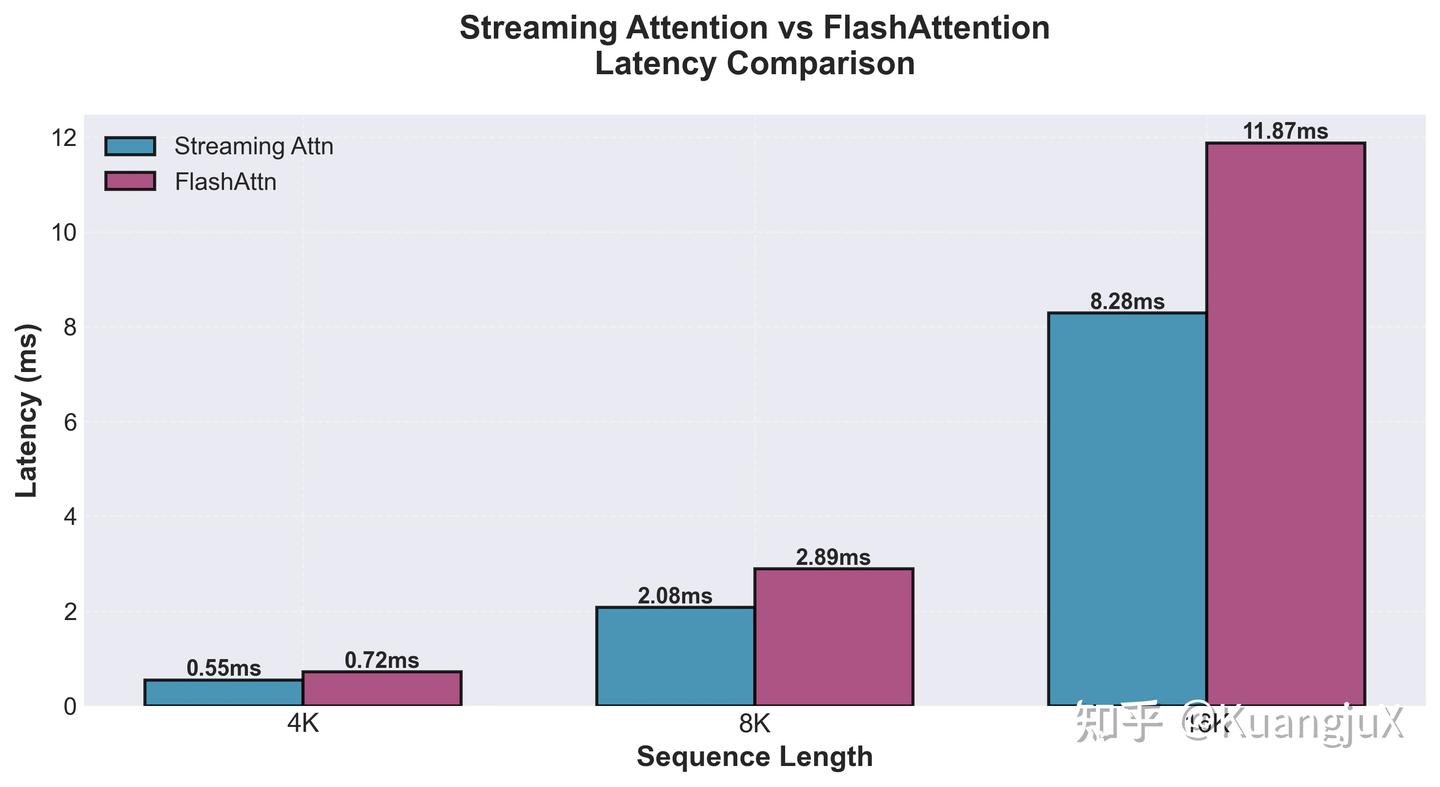
原图配置为单卡 H800,sink_size=128、recent_token=256,比较 streaming kernel 与 FlashAttention。它度量的是局部 attention 实现;没有在这里给出头划分、两分支调用、拼接及整个模型的分项消融,因而不能把 kernel 曲线直接换算成 SGLang 请求加速比。
参考
- ^Xiao G, Tang J, Zuo J, et al. Duoattention: Efficient long-context llm inference with retrieval and streaming heads[J]. arXiv preprint arXiv:2410.10819, 2024.
- ^Xiao G, Tian Y, Chen B, et al. Efficient streaming language models with attention sinks[J]. arXiv preprint arXiv:2309.17453, 2023.
- ^Tang J, Zhao Y, Zhu K, et al. Quest: Query-aware sparsity for effici
- ^Ainslie J, Lee-Thorp J, De Jong M, et al. Gqa: Training generalized multi-query transformer models from multi-head checkpoints[J]. arXiv preprint arXiv:2305.13245, 2023.
- ^https://github.com/mit-han-lab/duo-attention
- ^https://github.com/mit-han-lab/Block-Sparse-Attention